Educational scope. This article supports professional learning and case discussion. It is not patient-specific advice, a clinical protocol or a substitute for supervised training.
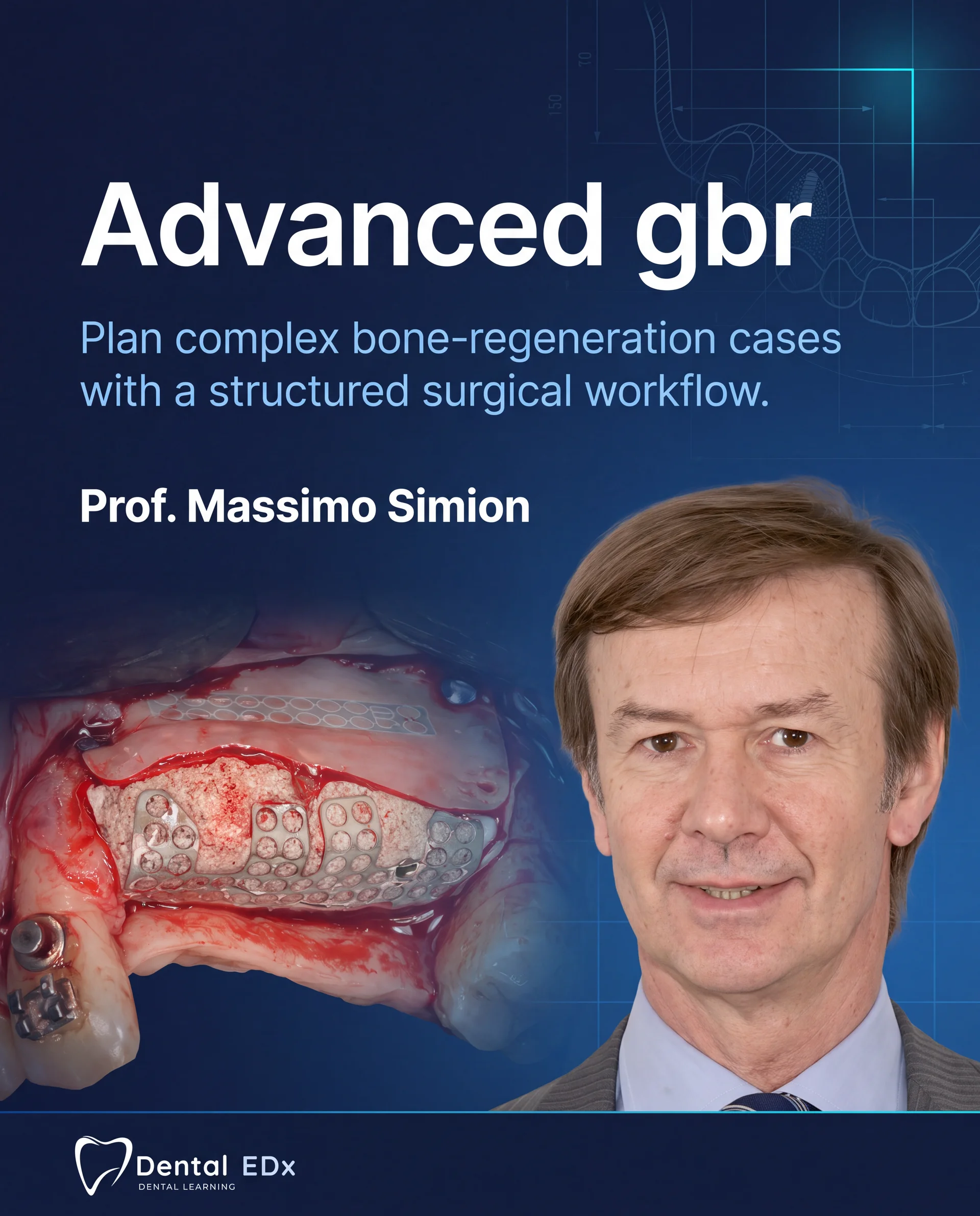
Vertical reconstruction is not a suitable topic for learning from an isolated before-and-after image. When selecting advanced education, look for a full account of diagnosis, alternative treatment options and how the team evaluated the result over time.
CLINICAL TAKEAWAY
What matters most
- Look for alternatives and rationale.
- Require discussion of complications.
- Evaluate the restorative endpoint.
EVIDENCE LENS
The AO/AAP consensus emphasizes biological and prosthetic factors in implant outcomes. Dimensional reconstruction alone is not a complete outcome assessment.
Ask for the reason behind the target
A presentation should explain the restorative problem that motivated reconstruction. Record why the proposed correction was needed, what other approaches were discussed and what evidence supported the plan. Avoid treating a large dimensional gain as the only measure of a useful outcome.
Evaluate what the course makes visible
Check whether lessons include treatment planning, surgical reasoning, healing review and complication management rather than only operative footage. For your own study notes, separate what the instructor demonstrates from what you would need supervised experience to perform.
Compare the endpoint with the original objective
Return to the initial restorative goal when reviewing follow-up. Ask whether the final prosthesis, patient experience and maintenance demands are described. An educational case is most informative when it connects the reconstruction to the treatment it was intended to support, including any revisions to the original sequence.
Advanced education should show the decision boundary
The most useful masterclass explains which defects, patient factors and restorative objectives led to treatment—and which would have led to referral, modification or an alternative. Operative footage without this boundary teaches motion more readily than judgment.
Judge the endpoint against the original prosthetic goal
Follow-up should reconnect the reconstructed ridge with the implant position, restoration, patient experience and maintenance demands. A dimensional gain is not a complete account of whether the rehabilitation achieved its intended purpose.
Turn the topic into a structured team review
Choose one de-identified case that raises the question of vertical ridge augmentation. Review it in stages rather than jumping to the final image: define the patient-centered objective, list the available records, identify who made each decision and mark every assumption or missing item. Then compare the sequence with the cited evidence and the applicable manufacturer or professional guidance. The objective is to understand why this pathway was selected, not to reproduce a technique from an article.
Repeat the review after delivery or follow-up and ask what the team would change. Use these checkpoints: Look for alternatives and rationale. Require discussion of complications. Evaluate the restorative endpoint. Record disagreements between the clinical, technical and maintenance perspectives instead of forcing an immediate consensus. A short, documented calibration exercise makes the article useful to the whole team and creates questions that can be taken into formal education, mentoring or supervised practice.
TAKE INTO YOUR NEXT CASE DISCUSSION
Three points to keep in view
- Look for alternatives and rationale.
- Require discussion of complications.
- Evaluate the restorative endpoint.
Evidence & references
The AO/AAP consensus emphasizes biological and prosthetic factors in implant outcomes. Dimensional reconstruction alone is not a complete outcome assessment.
- AO/AAP consensus on prevention and management of peri-implant diseases and conditions (2025) Wang et al. · Journal of Periodontology
References support the evidence discussion, not an endorsement of DentalEDX. Practical study prompts are editorial suggestions. No patient outcomes or professional accreditation are promised.
A common question
Is an online advanced course sufficient preparation for independent surgery?
No. Recorded teaching supports learning but does not replace suitable clinical training, supervision or assessment of competence.
CONTINUE LEARNING
Explore this topic in more depth.
Review the curriculum and prerequisites to choose teaching that fits your experience.