Educational scope. This article supports professional learning and case discussion. It is not patient-specific advice, a clinical protocol or a substitute for supervised training.
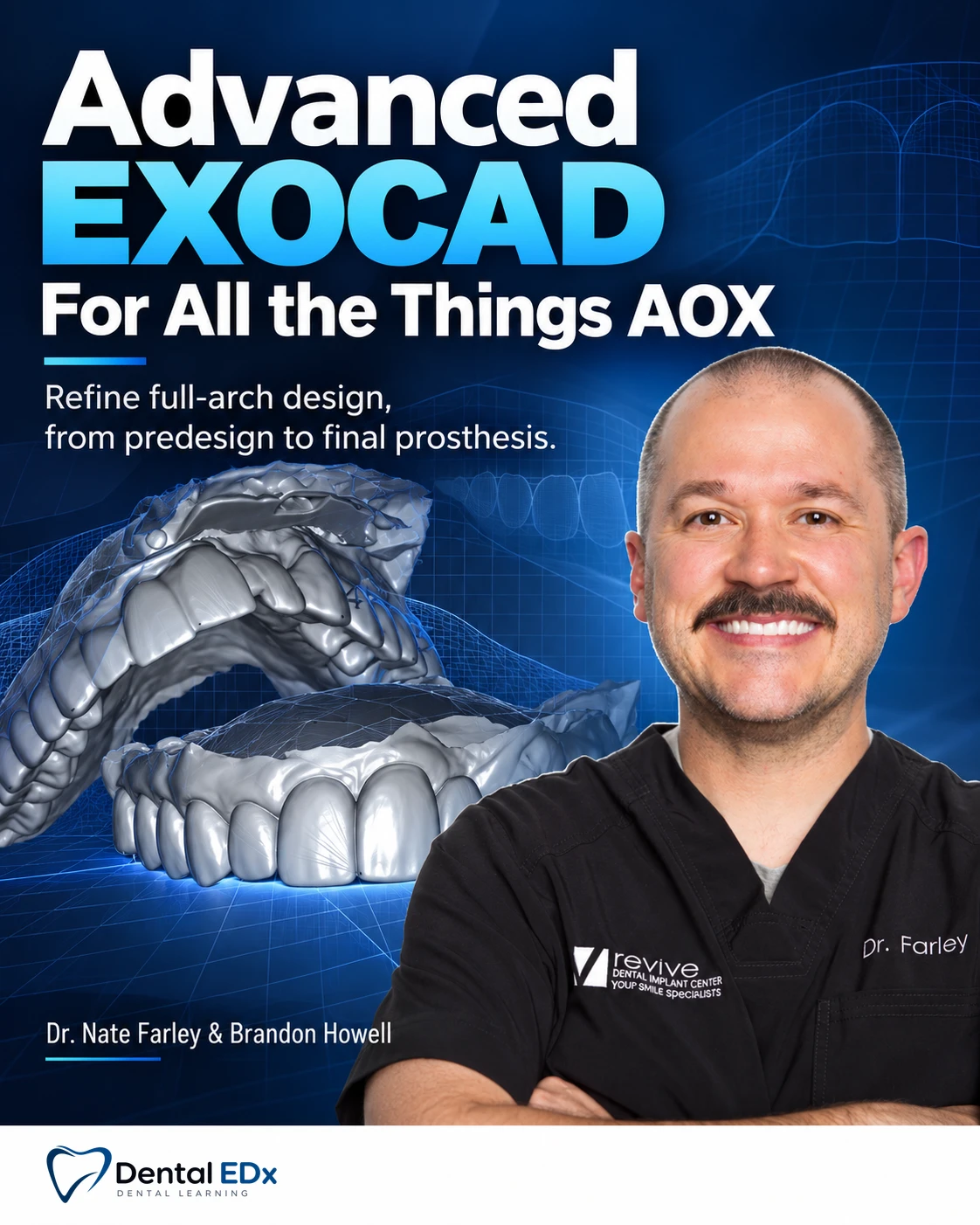
A complete-arch design contains many locally attractive details that must work as one prosthetic system. The review should move from patient-facing objectives to structural and maintenance requirements before surface characterization.
CLINICAL TAKEAWAY
What matters most
- Orient to the face.
- Review hidden surfaces.
- Check structure and CAM limits.
EVIDENCE LENS
Advanced CAD modules can support full-arch design, but reliable outcomes depend on restorative planning, verified records and manufacturing constraints.
Begin with facially oriented objectives
Review tooth display, midline, occlusal plane, lip support and the planned transition zone using the available records.
Interrogate the intaglio and interfaces
Evaluate component relationships, tissue contact, cleansability and access. Hidden surfaces can determine long-term usability even though they are absent from the final smile image.
Review structure and production constraints
Connector dimensions, material thickness, screw channels, segmentation and CAM strategy interact. A change in one area can affect the rest of the design.
Use the provisional as evidence
Speech, function, esthetics and hygiene feedback from a provisional phase should inform the definitive design rather than being discarded when the final CAD file is opened.
Run separate reviews for different risks
Use one review for facial and dental esthetics, another for tissue transition and hygiene, another for components and structure, and a final review for CAM. Combining everything into one fast screen share makes important hidden surfaces compete with the smile for attention.
Invite the appropriate team member to each decision. Clinical, surgical, technical and maintenance perspectives may reveal different constraints. The design becomes stronger when those constraints are resolved explicitly instead of being discovered independently at delivery.
Turn the topic into a structured team review
Choose one de-identified case that raises the question of full arch exocad design. Review it in stages rather than jumping to the final image: define the patient-centered objective, list the available records, identify who made each decision and mark every assumption or missing item. Then compare the sequence with the cited evidence and the applicable manufacturer or professional guidance. The objective is to understand why this pathway was selected, not to reproduce a technique from an article.
Repeat the review after delivery or follow-up and ask what the team would change. Use these checkpoints: Orient to the face. Review hidden surfaces. Check structure and CAM limits. Use provisional feedback. Record disagreements between the clinical, technical and maintenance perspectives instead of forcing an immediate consensus. A short, documented calibration exercise makes the article useful to the whole team and creates questions that can be taken into formal education, mentoring or supervised practice.
TAKE INTO YOUR NEXT CASE DISCUSSION
Three points to keep in view
- Orient to the face.
- Review hidden surfaces.
- Check structure and CAM limits.
- Use provisional feedback.
Evidence & references
Advanced CAD modules can support full-arch design, but reliable outcomes depend on restorative planning, verified records and manufacturing constraints.
- DentalCAD Implant Module exocad · Manufacturer documentation
- DentalCAD: features and add-on modules exocad · Manufacturer documentation
References support the evidence discussion, not an endorsement of DentalEDX. Practical study prompts are editorial suggestions. No patient outcomes or professional accreditation are promised.
A common question
Should full-arch review begin with tooth texture?
No. Position, transition, interfaces, structure and maintenance should be settled before fine surface detail.
CONTINUE LEARNING
Explore this topic in more depth.
Review the curriculum and prerequisites to choose teaching that fits your experience.