General and restorative dentists
Recognize why joint morphology and changes in the bite matter before restorative treatment.
Search courses, instructors, specialties and techniques.
Connect CBCT and MRI findings with joint anatomy, airway relationships and occlusal change.
With Dr. Dania Tamimi
Course information
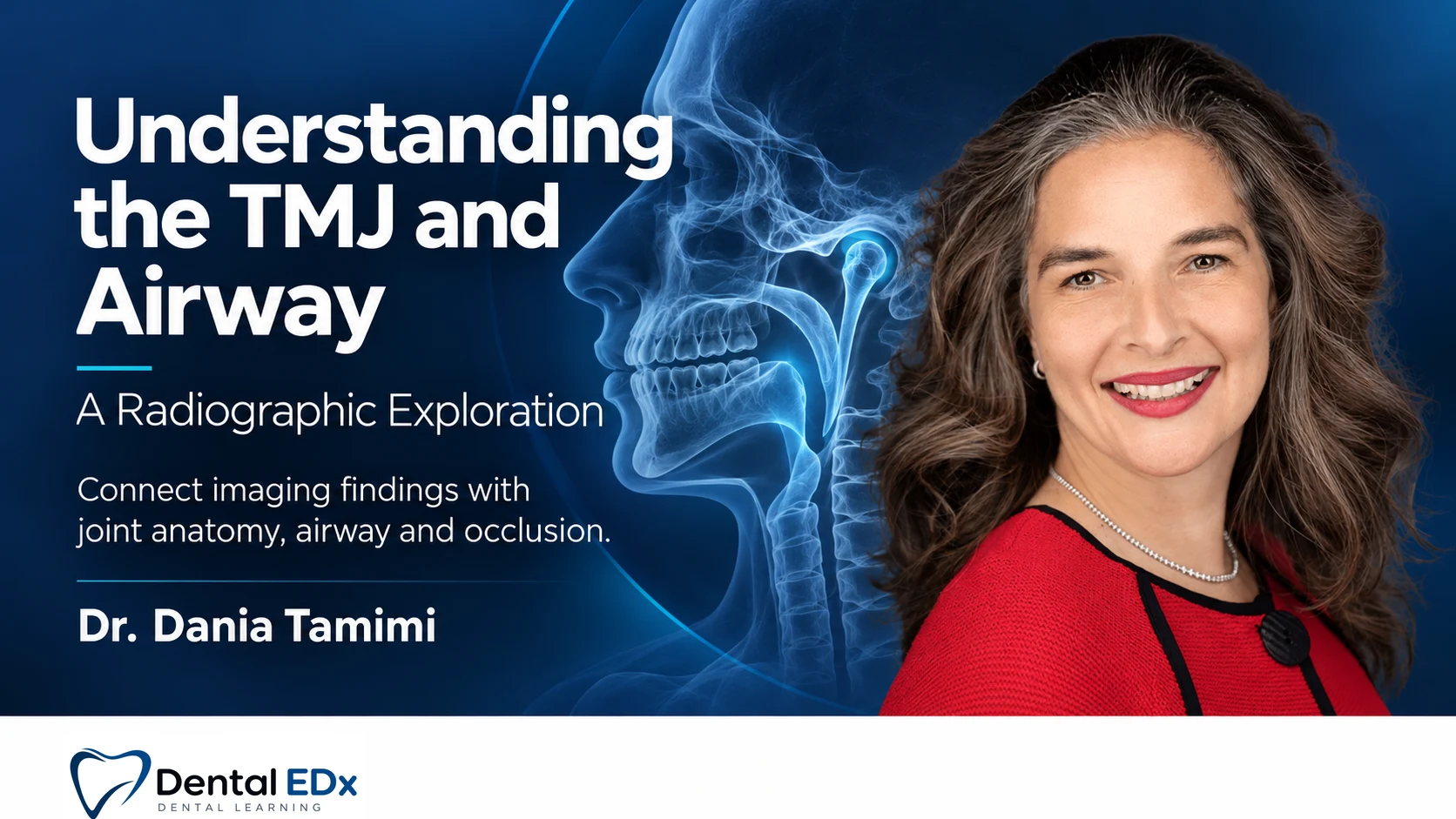
Explore the temporomandibular joints and upper respiratory tract with Dr. Dania Tamimi. This course brings normal anatomy, joint development and changes in craniofacial form into a radiographic discussion of TMD and sleep-disordered breathing.
Review the complementary roles of CBCT and MRI, then consider how joint and airway findings relate to occlusion and restorative planning. The focus is on recognizing clues and connecting imaging with the wider clinical assessment—not diagnosing a breathing disorder from an image alone.
The DentalEDX recording includes four sessions totaling 8 hours and 53 minutes. Study the sessions in order or revisit them as a reference alongside your existing clinical and imaging knowledge.
Who this course is for
Most relevant to clinicians with a foundation in dental anatomy and imaging who want to connect joint, airway and occlusal findings.
Recognize why joint morphology and changes in the bite matter before restorative treatment.
Explore relationships between craniofacial development, occlusion and the airway.
Review imaging anatomy and the complementary information provided by CBCT and MRI.
Radiographic assessment
Connect anatomy and imaging findings with the patient’s history and clinical presentation.
The course examines the relationships between the temporomandibular joints, craniofacial form, upper airway and occlusion. Use that broader view to identify questions for further assessment and multidisciplinary discussion.
Recognize the finding, understand its anatomical context and consider what needs further investigation.
What you’ll learn
Review the joint structures and anatomical landmarks used in radiographic assessment.
Explore the different views of joint anatomy provided by the two imaging modalities.
Follow the upper respiratory tract and its relationship to the craniofacial complex.
Examine how development and joint dysfunction can be reflected in craniofacial form.
Consider radiographic clues within the wider assessment of TMD and sleep-disordered breathing.
Relate changes in the bite to questions that matter for restorative and prosthodontic planning.
Joint, airway and occlusion
Move between joint anatomy, upper-airway relationships and changes in craniofacial morphology. Consider how those observations can inform the discussion before a restorative or orthodontic plan is finalized.
Course curriculum
The session names, order and runtimes below follow the DentalEDX curriculum.
 TMJ, Occlusion & Functional
Your instructor
Oral and maxillofacial radiologist · BDS, DMSc
Dr. Dania Tamimi earned her dental degree at King Saud University and completed her Doctor of Medical Science and oral and maxillofacial radiology training at Harvard School of Dental Medicine in 2005. A board-certified oral and maxillofacial radiologist, she is the lead author of Specialty Imaging: Temporomandibular Joint and Sleep-Disordered Breathing and Specialty Imaging: Dental Implants. She lectures internationally and practices oral and maxillofacial radiology in Orlando, Florida.
Your learning experience
Follow all four sessions, then revisit the anatomical relationships you want to examine in more depth.
Connect joint and upper-airway imaging with the course’s discussion of occlusal change.
Download the course videos and included materials for offline review.
Learn at your own pace and return to the recordings without a completion deadline.
Access your course on desktop, tablet or mobile.
Frequently asked
Need help choosing the right course? Contact support@dentaledx.com.
After payment, you receive access to your membership area and purchased course. Use the email address provided during checkout. If you have any access issue, contact support@dentaledx.com.
Yes. Course videos and included learning materials can be downloaded for offline review.
No. Your purchase includes lifetime access, so you can learn at your own pace and revisit the course.
Major cards and PayPal are accepted. Apple Pay, Google Pay, Klarna, Afterpay and other local methods may appear depending on your country.
Yes. A certificate of completion is provided after you complete the course requirements.
DentalEDX uses a digital-first learning model that reduces traditional education and distribution costs, making clinical education more accessible worldwide.
Yes. Courses can be accessed on desktop, laptop, tablet or mobile phone.
A purchase confirmation and receipt are sent to the email used at checkout. Contact support@dentaledx.com if you need additional invoice information.
You can request a refund within 48 hours of purchase or a course replacement within 7 days of purchase. Email support@dentaledx.com with your order details. These are request windows, not processing times. See our Refund Policy in the footer.
Courses include multilingual subtitle support. If you need a language that is not available, contact support@dentaledx.com.
Choose “Forgot password?” on the login page and follow the email instructions. If you still need help, contact support@dentaledx.com.
Ready when you are
Follow the course at your pace with lifetime access.