General dentists
Develop a structured approach to patients reporting jaw pain, restricted opening or symptoms that may not originate in the teeth.
Search courses, instructors, specialties and techniques.
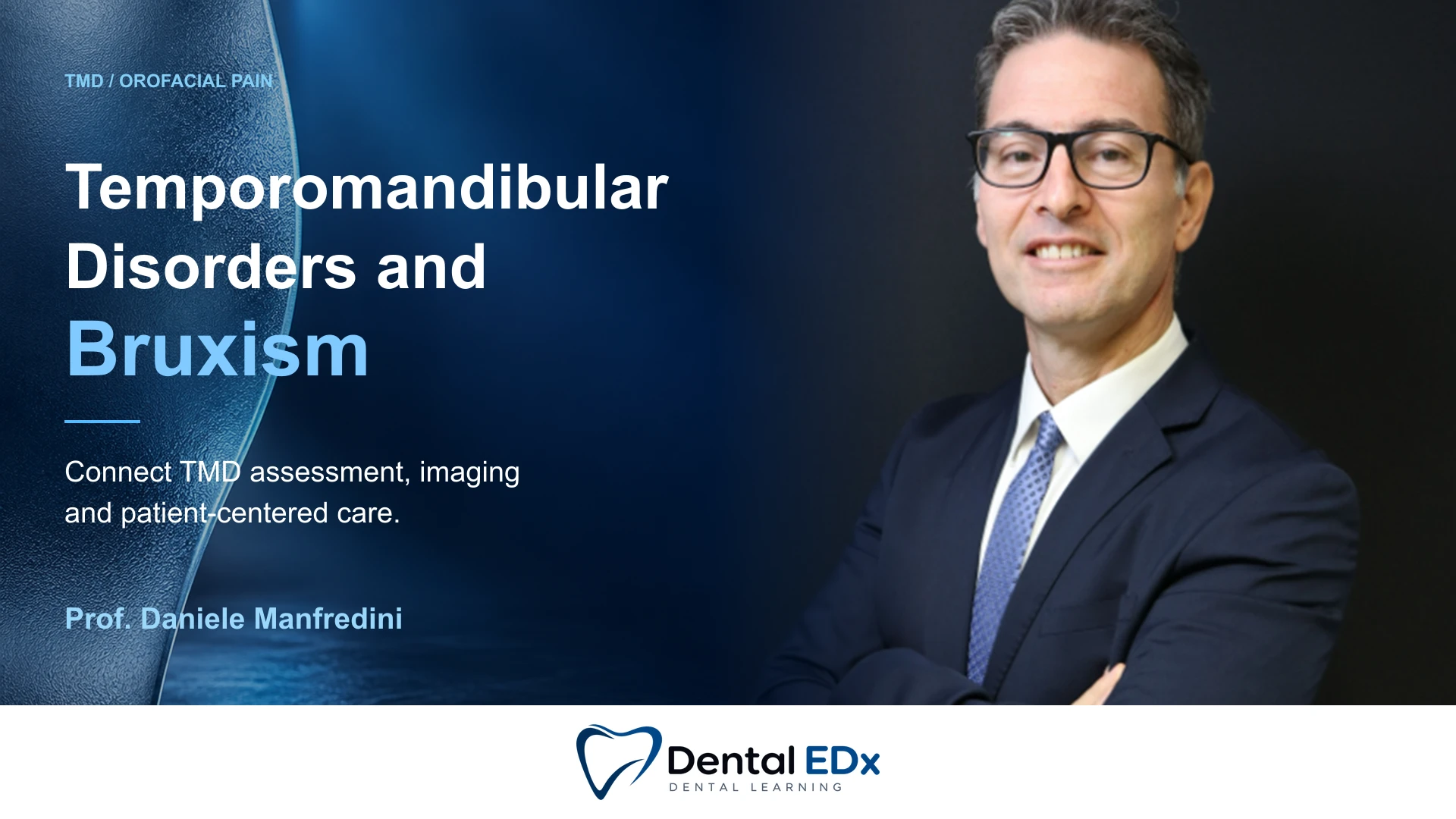
Connect TMD assessment, imaging and patient-centered care.
With Prof. Daniele Manfredini
Course information
Study temporomandibular disorders and bruxism through seven theoretical lectures and twelve clinical videos with Prof. Daniele Manfredini. Move from joint physiopathology and the overload concept to assessment, imaging and management.
The course explores the Multiple-P approach and the biopsychosocial model of pain, connecting patient history and clinical findings with a range of management options. Oral appliances and arthrocentesis are considered within that wider clinical context.
Follow 19 recordings totaling 7 hours and 51 minutes. Clinical examples include limited mouth opening, closed lock, muscle tension, neuropathic pain, joint arthritis and follow-up visits. This is professional education for qualified dental practitioners, not a substitute for supervised procedural training.
Who this course is for
Build on your knowledge of dental anatomy and clinical examination with a focused introduction to TMD and orofacial pain management.
Develop a structured approach to patients reporting jaw pain, restricted opening or symptoms that may not originate in the teeth.
Consider joint symptoms, bruxism and functional findings before deciding on restorative intervention.
Review clinical cases, imaging and management choices through a patient-centered framework.
A broader view of pain
Pain, function, imaging and the patient’s experience belong in the same assessment.
The course introduces the Multiple-P approach: patient education, physiotherapy, psychological re-education, plates and pills. Explore how these options fit within the biopsychosocial model, rather than assuming every complaint requires a dental procedure.
Listen to the complaint. Assess the function. Put the findings in context.
What you’ll learn
Review joint physiopathology and the overload concept as foundations for understanding symptoms.
Explore the definition of bruxism and what it means for clinical assessment and patient communication.
Relate TMJ imaging to the patient’s history, clinical findings and functional presentation.
Study the Multiple-P approach and the biopsychosocial factors considered in orofacial pain care.
Follow appliance construction and review mechanisms of action in the management of TMJ disorders.
Observe arthrocentesis protocols and case reviews involving closed lock, arthritis and limited opening.
Clinical case review
Twelve clinical videos extend the theory into patient presentations and procedures. Review diagnostic protocols, an unclear chief complaint, appliance construction and follow-up. Compare presentations with and without pain, and consider what each adds to the assessment.
Course curriculum
Start with the theoretical foundations, then follow the clinical recordings in sequence or revisit a specific presentation.
 TMJ, Occlusion & Functional
Your instructor
Dentist, researcher and educator in TMD and orofacial pain
Prof. Daniele Manfredini focuses his clinical and research work on temporomandibular disorders, bruxism and orofacial pain. He graduated in dentistry from the University of Pisa and completed a PhD at the University of Amsterdam. His teaching brings clinical assessment, imaging and the biopsychosocial understanding of pain into a patient-centered approach to care.
Your learning experience
Move between the lectures and clinical cases as you consolidate your understanding.
Combine seven theoretical lectures with twelve focused clinical recordings.
Download the videos and included materials for offline review.
Return to the recordings at your own pace without a completion deadline.
Access the course on desktop, tablet or mobile.
Frequently asked
Need help choosing the right course? Contact support@dentaledx.com.
After payment, you receive access to your membership area and purchased course. Use the email address provided during checkout. If you have any access issue, contact support@dentaledx.com.
Yes. Course videos and included learning materials can be downloaded for offline review.
No. Your purchase includes lifetime access, so you can learn at your own pace and revisit the course.
Major cards and PayPal are accepted. Apple Pay, Google Pay, Klarna, Afterpay and other local methods may appear depending on your country.
Yes. A certificate of completion is provided after you complete the course requirements.
DentalEDX uses a digital-first learning model that reduces traditional education and distribution costs, making clinical education more accessible worldwide.
Yes. Courses can be accessed on desktop, laptop, tablet or mobile phone.
A purchase confirmation and receipt are sent to the email used at checkout. Contact support@dentaledx.com if you need additional invoice information.
You can request a refund within 48 hours of purchase or a course replacement within 7 days of purchase. Email support@dentaledx.com with your order details. These are request windows, not processing times. See our Refund Policy in the footer.
Courses include multilingual subtitle support. If you need a language that is not available, contact support@dentaledx.com.
Choose “Forgot password?” on the login page and follow the email instructions. If you still need help, contact support@dentaledx.com.
Ready when you are
Follow the course at your pace with lifetime access.