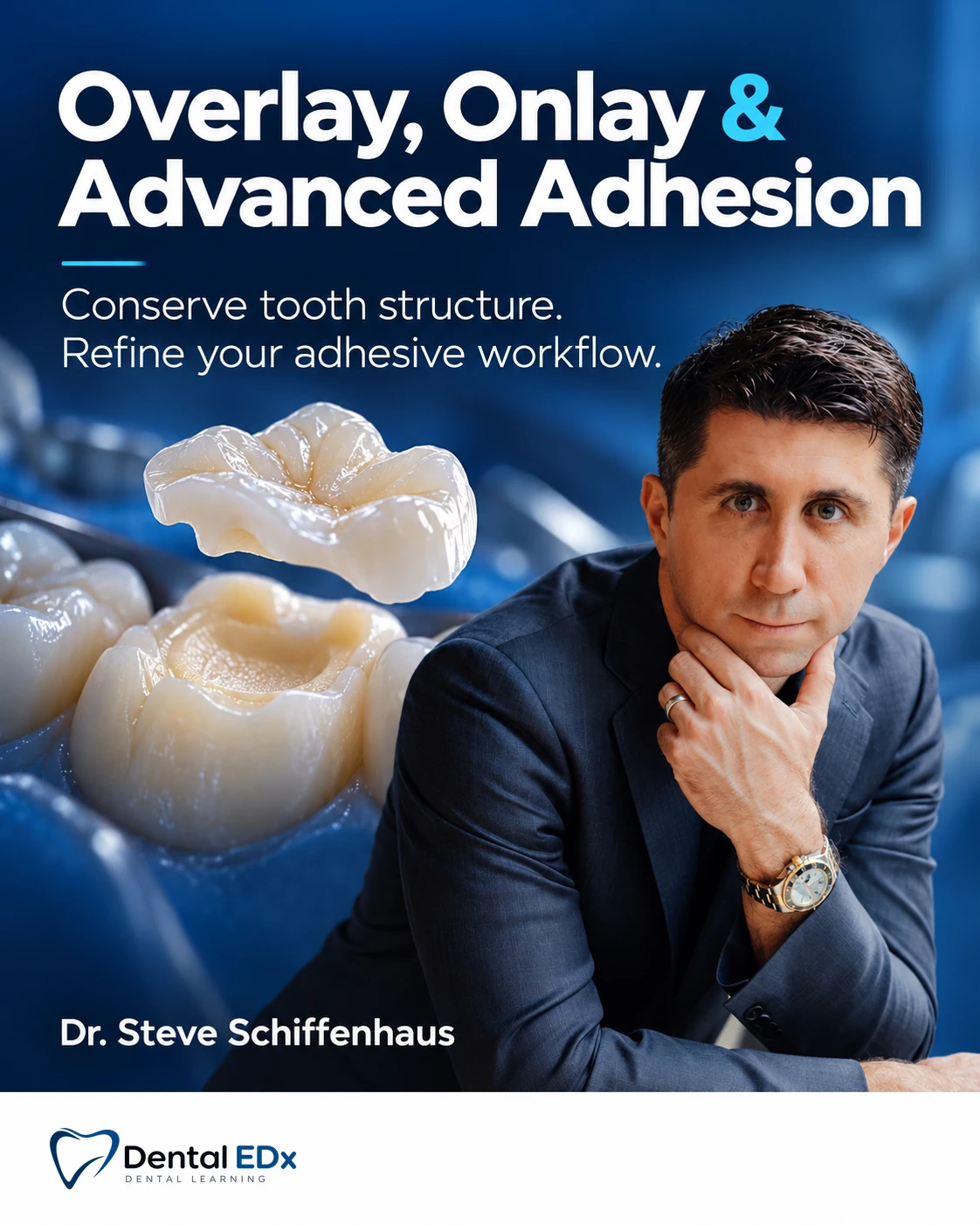
Educational scope. This article supports professional learning and case discussion. It is not patient-specific advice, a clinical protocol or a substitute for supervised training.
A restoration label is useful only after the clinical problem has been defined. When comparing onlays, overlays and crowns, focus on the proposed coverage and rationale rather than assuming that a less extensive name always means a better treatment.
CLINICAL TAKEAWAY
What matters most
- Document the tooth condition.
- Clarify the actual design.
- Connect material and delivery to the indication.
EVIDENCE LENS
The ADA’s indirect-restoration resource describes material and cementation choices as dependent on clinical context.
Describe what remains
A case presentation should explain the condition of the tooth and existing restorations. Identify which findings are documented and which are not available. The amount of tissue visible in one image is not a complete assessment of the tooth’s restorative needs.
Make the proposed coverage explicit
Ask the instructor to explain which structures the design covers and why. Terminology may vary between resources, so a drawing or described design is more useful than the label alone. Compare alternatives against the same treatment objective.
Treat material and delivery as connected decisions
Review how the chosen material relates to the proposed design and the applicable bonding or cementation process. A partial-coverage restoration is not defined only by preparation size. For learning, keep diagnosis, design, material and delivery together rather than studying them as unrelated tips.
Name the tissue and structure being preserved
The terminology is useful only when tied to the remaining tooth, cuspal coverage, margin design and restorative objective. A label alone does not determine preparation or material.
Evaluate the tooth-restoration system
Substrate quality, pulpal status, cracks, ferrule needs, occlusion and bonding conditions may shift the plan. Education should show how these findings change the design rather than presenting one preparation as the universal conservative choice.
Turn the topic into a structured team review
Choose one de-identified case that raises the question of onlay preparation. Review it in stages rather than jumping to the final image: define the patient-centered objective, list the available records, identify who made each decision and mark every assumption or missing item. Then compare the sequence with the cited evidence and the applicable manufacturer or professional guidance. The objective is to understand why this pathway was selected, not to reproduce a technique from an article.
Repeat the review after delivery or follow-up and ask what the team would change. Use these checkpoints: Document the tooth condition. Clarify the actual design. Connect material and delivery to the indication. Record disagreements between the clinical, technical and maintenance perspectives instead of forcing an immediate consensus. A short, documented calibration exercise makes the article useful to the whole team and creates questions that can be taken into formal education, mentoring or supervised practice.
TAKE INTO YOUR NEXT CASE DISCUSSION
Three points to keep in view
- Document the tooth condition.
- Clarify the actual design.
- Connect material and delivery to the indication.
Evidence & references
The ADA’s indirect-restoration resource describes material and cementation choices as dependent on clinical context.
- Materials for Indirect Restorations American Dental Association
References support the evidence discussion, not an endorsement of DentalEDX. Practical study prompts are editorial suggestions. No patient outcomes or professional accreditation are promised.
A common question
Is an overlay always preferable to a crown?
No. The appropriate option follows the individual assessment and the evidence relevant to that situation.
CONTINUE LEARNING
Explore this topic in more depth.
Review the curriculum and prerequisites to choose teaching that fits your experience.