Orthodontists and orthodontic trainees
Build a systematic approach to landmarks, jaw relationships and skeletal growth patterns.
Search courses, instructors, specialties and techniques.
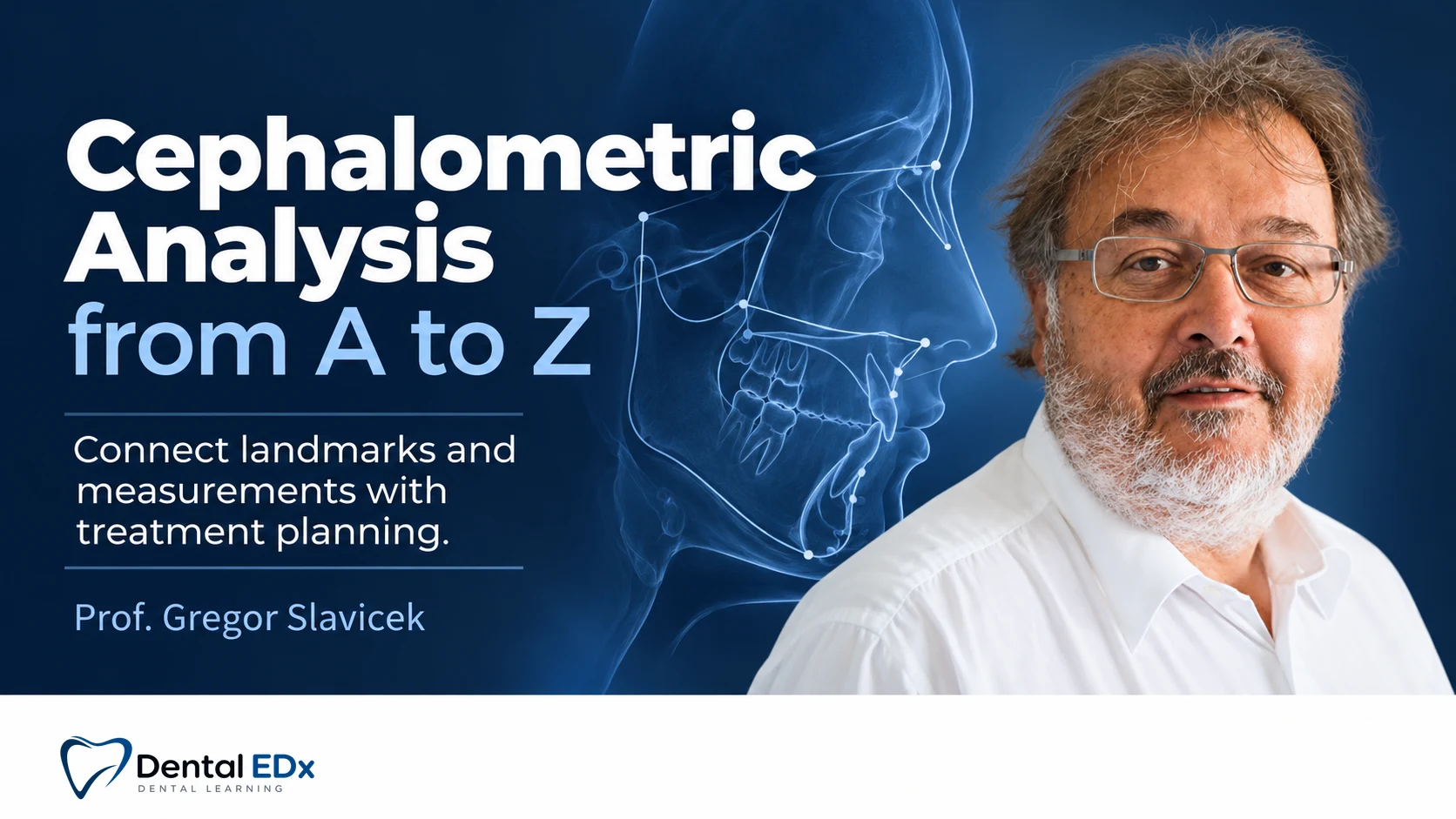
Connect cephalometric landmarks and measurements with skeletal, dental and occlusal treatment planning.
With Prof. Gregor Slavicek
Course information
Prof. Gregor Slavicek guides you from identifying anatomical landmarks to interpreting planes, angles and the relationship between the jaws, teeth and cranial base. The 22-lesson sequence builds from tracing fundamentals to skeletal trends and occlusal assessment.
Later lessons explore the curve of Spee, vertical dimension and compensatory mechanisms before bringing these findings into prosthetic planning. The focus is on interpreting measurements in context—not treating a tracing as a set of isolated numbers.
Who this course is for
A structured introduction and reference for clinicians working with orthodontic assessment, functional dentistry or oral rehabilitation.
Build a systematic approach to landmarks, jaw relationships and skeletal growth patterns.
Explore how occlusal planes, facial height and compensatory mechanisms relate to the cephalogram.
Connect incisor position, vertical dimension and occlusal curvature with rehabilitation planning.
A systematic reading
A useful tracing begins with consistent landmarks and ends with a reasoned interpretation.
Work through anatomical structures first, then constructed planes and measurements. Use that foundation to examine skeletal trends, dental positions and the functional relationships discussed throughout the course.
Measurements gain meaning when you connect them to the skeletal and occlusal context.
What you’ll learn
Identify cranial-base, maxillary, mandibular, dental and soft-tissue reference points.
Follow the sequence from reference points to the measurements used in cephalometric analysis.
Review skeletal class, high- and low-angle patterns and the capacity for functional adaptation.
Connect anterior tooth and molar analysis with occlusal inclination and the curve of Spee.
Distinguish vertical, dentoalveolar and articular compensation when interpreting the findings.
Relate lower facial height, vertical dimension and cephalometric parameters to prosthetic decisions.
Beyond the tracing
The second half of the course moves from skeletal and dental analysis into vertical dimension, occlusal curvature and compensation. These topics lead into the final lesson on prosthetic parameters in cephalometry.
Course curriculum
Review the complete lesson list and available runtimes.
 Orthodontics
Your instructor
Dentist · Functional dentistry and oral rehabilitation educator
Prof. Gregor Slavicek trained in medicine and dentistry at the University of Vienna and completed postgraduate orthodontic training in Aarhus, Denmark. His teaching and research connect cephalometry, occlusal function and oral rehabilitation. His academic background includes a professorship at Steinbeis University Berlin and a Master of Science in Clinical Research from Vienna Medical University.
Your learning experience
Follow all 22 lessons in order, then return to the tracing or interpretation topic you need to review.
Move from landmark identification to interpretation through a structured lesson sequence.
Download course videos and included materials for your own study.
Return to planes, skeletal patterns, compensation or prosthetic parameters whenever needed.
Pause and continue on desktop, tablet or mobile.
Frequently asked
Need help choosing the right course? Contact support@dentaledx.com.
After payment, you receive access to your membership area and purchased course. Use the email address provided during checkout. If you have any access issue, contact support@dentaledx.com.
Yes. Course videos and included learning materials can be downloaded for offline review.
No. Your purchase includes lifetime access, so you can learn at your own pace and revisit the course.
Major cards and PayPal are accepted. Apple Pay, Google Pay, Klarna, Afterpay and other local methods may appear depending on your country.
Yes. A certificate of completion is provided after you complete the course requirements.
DentalEDX uses a digital-first learning model that reduces traditional education and distribution costs, making clinical education more accessible worldwide.
Yes. Courses can be accessed on desktop, laptop, tablet or mobile phone.
A purchase confirmation and receipt are sent to the email used at checkout. Contact support@dentaledx.com if you need additional invoice information.
You can request a refund within 48 hours of purchase or a course replacement within 7 days of purchase. Email support@dentaledx.com with your order details. These are request windows, not processing times. See our Refund Policy in the footer.
Courses include multilingual subtitle support. If you need a language that is not available, contact support@dentaledx.com.
Choose “Forgot password?” on the login page and follow the email instructions. If you still need help, contact support@dentaledx.com.
Ready when you are
Follow the course at your pace with lifetime access.